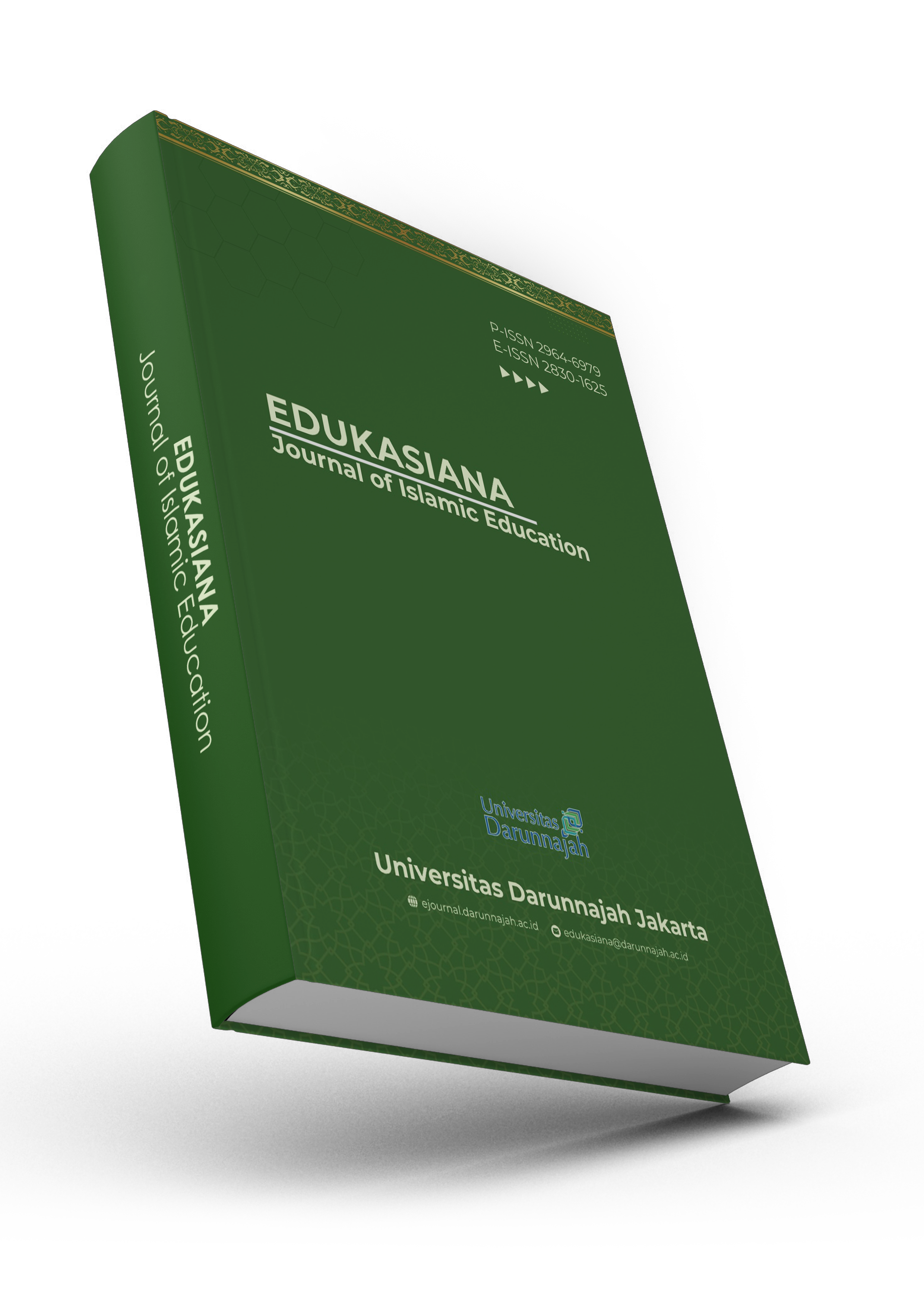
Quality Management in Arabic Language Learning Integrating Technology and Islamic Values in the Society 5.0 Era
DOI:
https://doi.org/10.61159/edukasiana.v5i1.802Keywords:
Arabic Language Learning, Islamic Values, Quality Management, Society 5.0, Technology IntegrationAbstract
The transition toward Society 5.0 has obliged Islamic educational institutions in Indonesia to reconsider how Arabic is planned, delivered, and evaluated. Although digital tools grow abundant every year, discussions about quality tend to stop at whether the technology functions, not whether it truly upholds the spiritual and pedagogical mission of Arabic as the language of the Qur'an. This article addresses that concern through a Systematic Literature Review (SLR) following the PRISMA 2020 protocol. Forty-two peer-reviewed articles published between 2020 and 2025 were selected from Scopus, DOAJ, and SINTA 1–2 indexed journals. Thematic synthesis yielded three interrelated findings: first, effective quality management rests on leadership that is digitally literate yet anchored in adab; second, technology integration succeeds when teachers are treated as co-designers rather than end-users; third, Islamic values work only when embedded in the structural decisions of the institution, not when treated as decorative additions. A conceptual framework that bridges total quality management, human-centered technology integration, and the integration of Islamic values into the curriculum is presented. The review contributes to the discourse on digital transformation in Islamic education and outlines priorities for empirical research in madrasah and pesantren settings.
References
Albahuoth, H. (2023). Effectiveness of the flipped classroom in developing 11th graders’ grammatical competencies in Arabic. Interactive Learning Environments, 31(2), 1089–1105. https://doi.org/10.1080/10494820.2020.1821714
Almelhes, S. A. (2024). Gamification for teaching the Arabic language to non-native speakers: A systematic literature review. Frontiers in Education, 9, 1371955. https://doi.org/10.3389/feduc.2024.1371955
Arif, M., Kartiko, A., Rusydi, I., Zamroni, M. A., & Hasan, M. S. (2024). The existence of Madrasah Ibtidaiyah based on Pesantren: Challenges and opportunities in the digital era. Munaddhomah: Jurnal Manajemen Pendidikan Islam, 5(4), 367–382. https://doi.org/10.31538/munaddhomah.v5i4.1401
Atabik, A., Yahya, M., & Mustajab, M. (2024). Arabic language learning models in schools: A comparative study of Islamic boarding school-based Madrasah Aliyah in Kebumen, Indonesia. International Journal of Religion, 5(3), 287–301. https://doi.org/10.61707/wnd15a15
Braun, V., & Clarke, V. (2019). Reflecting on reflexive thematic analysis. Qualitative Research in Sport, Exercise and Health, 11(4), 589–597. https://doi.org/10.1080/2159676X.2019.1628806
Cuban, L. (1986). Teachers and machines: The classroom use of technology since 1920. Teachers College Press.
Deguchi, A., Hirai, C., Matsuoka, H., Nakano, T., Oshima, K., Tai, M., & Tani, S. (2020). What is Society 5.0? In Society 5.0: A people-centric super-smart society (pp. 1–23). Springer. https://doi.org/10.1007/978-981-15-2989-4_1
Ghufron, Z., Alawiyyah, A., & Kuakul, Y. (2025). Integration of Arabic language learning in the formation of social-religious identity in madrasahs: A systematic study of policy, local practices, and digital transformation. Al-Jadwa: Jurnal Studi Islam, 5(1), 149–163. https://doi.org/10.38073/aljadwa.3567
Greentree, T., Muhtar, A., & Madrah, M. Y. (2025). Islamic education for adult new Muslims (mualaf) in the global era: a comparison of Malaysian and Indonesian curricula. Edukasiana: Journal of Islamic Education, 4(2), 410–420. https://doi.org/10.61159/edukasiana.v4i2.566
Haddade, H., Nur, A., Achruh, A., Rasyid, M. N. A., & Ibrahim, A. (2024). Madrasah management strategies through the Madrasah Reform program: Evidence from Indonesia. International Journal of Educational Management, 38(5), 1289–1304. https://doi.org/10.1108/IJEM-05-2023-0236
Islami, A. (2025). Peran Pesantren Darunnajah Jakarta Dalam Pendidikan Karakter Santri Melalui Pembelajaran Bahasa Arab. Nuansa Akademik: Jurnal Pembangunan Masyarakat, 10(1), 335–348. https://doi.org/10.47200/jnajpm.v10i1.2914
Islami, A., Abdullah, A. F., Ibrohim, B., & Saputra, F. R. (2025). Al-’Awamil al-Mu’atstsirah ’ala Lughat al-Umm fi Iktisab al-Lughah al-’Arabiyyah li al-Thullab al-Judud fi Ma’ahid Dar al-Najah al-Islamiyyah bi Jakarta. Al-Ittijah: Jurnal Keilmuan Dan Kependidikan Bahasa Arab, 17(1), 73–92. https://doi.org/10.32678/alittijah.v17i1.11441
Islami, A., Imroatun, I., Nurlaeli, N., Sajid, D. I. B., Samael, P., & Arifin, Z. (2023). Manajemen pembelajaran ilmu tajwid melalui nadhom di pesantren. Asas Wa Tandhim: Jurnal Hukum, Pendidikan Dan Sosial Keagamaan, 3(1), 21–30. https://doi.org/10.47200/awtjhpsa.v3i1.2051
Islami, A., Rostiana, I. N., Ibrahim, B., Novrizal, N., & Annas, I. K. (2025). Metode Muhadatsah: Pendekatan Komunikatif dalam Pembelajaran Bahasa Arab di Era Globalisasi di Pondok Pesantren Darunnajah. Proceedings of the 3rd International Conference on Pesantren (3rd ICOP) 2025.
Kemenag RI. (2024). Statistik pendidikan Islam tahun 2023–2024. Kementerian Agama Republik Indonesia.
Koderi, S., M., & Erlina. (2023). Developing Lampung local wisdom film on Arabic communication skills for Madrasah Tsanawiyah students. International Journal of Information and Education Technology, 13(12), 2004–2013. https://doi.org/10.18178/ijiet.2023.13.12.2015
Mudinillah, A., Kuswandi, D., Erwin, Sugiarni, Winarno, Annajmi, & Hermansah, S. (2024). Optimizing project-based learning in developing 21st century skills: A future education perspective. Qubahan Academic Journal, 4(2), 86–101. https://doi.org/10.48161/qaj.v4n2a352
Nastiti, F. E., & Abdu, A. R. N. (2020). Kesiapan pendidikan Indonesia menghadapi era Society 5.0. Edcomtech: Jurnal Kajian Teknologi Pendidikan, 5(1), 61–66. https://doi.org/10.17977/um039v5i12020p061
Nasution, S., Asari, H., Al-Rasyid, H., Dalimunthe, R. A., & Rahman, A. (2024). Learning Arabic language sciences based on technology in traditional Islamic boarding schools in Indonesia. Nazhruna: Jurnal Pendidikan Islam, 7(1), 77–102. https://doi.org/10.31538/nzh.v7i1.4222
Page, M. J., McKenzie, J. E., Bossuyt, P. M., Boutron, I., Hoffmann, T. C., Mulrow, C. D., & others. (2021). The PRISMA 2020 statement: An updated guideline for reporting systematic reviews. BMJ, 372, n71. https://doi.org/10.1136/bmj.n71
Sallis, E. (2014). Total quality management in education (3rd ed.). Routledge.
Snyder, H. (2019). Literature review as a research methodology: An overview and guidelines. Journal of Business Research, 104, 333–339. https://doi.org/10.1016/j.jbusres.2019.07.039
Sopian, A., Abdurahman, M., ’Ali, M., Tantowi, Y. A., Aeni, A. N., & Maulani, H. (2025). Arabic language learning in a multicultural context at pesantren. Jurnal Pendidikan Islam, 11(1), 77–89. https://doi.org/10.15575/jpi.v11i1.44104
Ubaedullah, D., Manaf, S., Rokimin, Rahman, M. H., & Kamilah, A. N. (2025). Pengembangan model kurikulum berbasis kecerdasan buatan untuk meningkatkan keterampilan abad ke-21 di sekolah menengah di Jakarta. Edukasiana: Journal of Islamic Education, 4(2), 439–455. https://doi.org/10.61159/edukasiana.v4i2.679
Zikriah, Z., & Mauludiyah, L. (2024). Research trend of Arabic language teaching in the world: Systematic literature review based on Scopus database. Research and Development in Education (RaDEn), 4(1), 27–48. https://doi.org/10.22219/raden.v4i1.31847